Nuñez
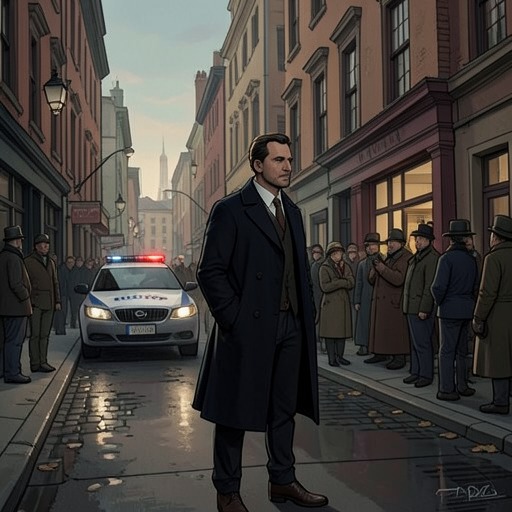
The Lost SymbolNuñez is a U.S. Capitol Police officer stationed at the Capitol Visitor Center whose small decisions help shape the escape of Robert Langdon and Warren Bellamy. First, he realizes that he admitted a dangerous intruder; later, he knowingly helps Bellamy and Langdon leave through a concealed tunnel. His part in the crisis is not defined by authority or expertise but by the pressure of choosing whom to obey—and by the consequences when surveillance exposes that choice.
Identity and First Security Failure
Nuñez is on duty at the Capitol Visitor Center, where his routine includes locking the main entrance doors each night. On the night of the crisis, he is already troubled by an earlier security failure: he had let a man wearing an army-surplus jacket into the building. In retrospect, he connects that lapse to the tattooed intruder and worries that he may lose his job. The concern is concrete and immediate; before he knows the wider stakes, Nuñez understands that a mistake on his watch may have serious professional consequences.
As he heads toward the escalator after closing the doors, an elderly man outside pounds on the glass and signals to be admitted. Nuñez initially points to his watch, indicating that the entrance is closed. When the visitor steps into the light, however, Nuñez recognizes Warren Bellamy, the Architect of the Capitol, and hurries back to unlock the door. Bellamy is immaculately dressed in a blue suit, and Nuñez’s recognition of his office changes the encounter at once: the closed entrance opens for a senior official who says he has heard about an incident in the building.
Nuñez tells Bellamy that Trent Anderson is downstairs with Inoue Sato of the Central Intelligence Agency’s Office of Security. Bellamy reacts with concern and asks why the Central Intelligence Agency is present. Nuñez cannot explain the agency’s involvement; he only relays what he knows from his radio. He then guides Bellamy toward the lower levels. When Bellamy asks to go down without being announced, Nuñez hesitates, aware that Anderson would ordinarily expect to be informed. Bellamy reminds him that Anderson is his employee, and Nuñez complies. In this early exchange, Nuñez’s deference to institutional rank is already visible, but it will soon be tested by conflicting orders and loyalties.
Helping Bellamy and Langdon Escape
Later, Nuñez encounters Bellamy again, this time with Langdon, after Bellamy has led Langdon through the United States Capitol’s underground corridors. The two men emerge into the Capitol Visitor Center, where Nuñez recognizes Langdon from the earlier security screening. Bellamy tells him not to say a word and orders him to follow. Nuñez looks uneasy but obeys, becoming an active participant rather than merely a witness to their movement through the building.
At a set of heavy doors sealed with masking tape and marked off with orange pylons, Bellamy peels away the tape and searches his key ring. He tells Nuñez that Anderson may be injured in the subbasement and instructs him to check on the chief. The instruction gives Nuñez a reason to leave the escape route, but Bellamy also makes the secrecy explicit: Nuñez must not acknowledge having seen the two men, even to Anderson. Bellamy unlocks the steel door, gives Nuñez the key, and tells him to lock the door behind them, restore the tape as best he can, and keep silent. Nuñez does so while Bellamy and Langdon pass through into a corridor under construction.
The choice has practical consequences. Nuñez’s cooperation helps conceal the tunnel route and delays the discovery of how the men left. He has been told both to protect the secret and to check on a chief who may need help; his actions serve Bellamy’s plan, while his later account shows that he understands Anderson’s authority and the risk of disobeying him. The scene makes the escape hinge on ordinary access—a key, a sealed door, and an officer willing to keep quiet—rather than on a spectacular confrontation.
Confession and Attempt to Protect Anderson
Nuñez’s silence does not last. Back at police headquarters, he sees Anderson holding an ice pack to his head and Sato being tended for bruises as they review surveillance footage to locate Langdon and Bellamy. A Central Intelligence Agency field team is preparing nearby to pursue the fugitives. Nuñez recognizes that the camera review is likely to reveal his role, and he decides to approach Anderson before the footage does. He admits that he saw Langdon and Bellamy leaving through the visitor center and says that he is resigning. His confession is driven by the certainty that discovery is imminent, but he does not wait to be confronted.
Nuñez gives Anderson the key Bellamy entrusted to him and explains that it opens the new tunnel under Independence Avenue. When Sato comes into the hall and notices the key, Nuñez improvises a cover story: he claims he found it on the floor in the subbasement and is asking Anderson what it unlocks. Anderson initially joins the attempt to evade her questions. Nuñez is therefore not simply confessing and accepting punishment; even after surrendering the evidence, he tries to protect his chief from immediate scrutiny.
Sato’s surveillance team has already found the relevant footage. She identifies Nuñez as the officer who helped Langdon and Bellamy escape and confirms that Bellamy gave him the key. Faced with the recording, Nuñez acknowledges what happened and explains that Bellamy told him not to tell anyone. Anderson angrily objects that Nuñez works for him, while Sato cuts off both men’s defenses, calls them poor liars, and takes the key. The exchange ends Nuñez’s attempt to control the account of his actions: the route, the handoff, and his participation are now established by the footage as well as by his admission.
Narrative Role
Nuñez’s arc links the book’s concealed passageways to the visible machinery of institutional surveillance. A routine security check first fails to stop the intruder; later, Nuñez’s access and cooperation make Bellamy and Langdon’s departure possible. Yet the same building that permits escape also records it, and the surveillance review turns his decision into a matter for Sato and the Central Intelligence Agency’s inquiry.
His conduct remains divided between obedience and conscience. He follows Bellamy’s instructions, then approaches Anderson to confess rather than simply wait for the cameras to expose him; at the same time, he tries to protect Anderson with a false explanation when Sato appears. The account does not resolve the consequences for his job, but it establishes the immediate cost of his involvement: his actions are known to the officials directing the investigation, and his own explanation cannot undo the escape. Nuñez’s brief presence gives the crisis a ground-level human scale, showing how a key decision made by a junior officer can matter even when he has neither the knowledge nor the power to control the larger operation.